Understanding AI Search SEO and Why Keyword Research Has Changed
AI search SEO has completely reshaped how keyword research works. Search engines no longer rely only on keyword matching. Instead, they interpret intent, context, and meaning. For an AI search SEO specialist, this shift is an opportunity—not a threat.
Modern AI-powered search engines analyze entire conversations, not isolated terms. They aim to deliver direct answers, summaries, and recommendations. That’s why keyword research must evolve from volume chasing to problem-solving.
How AI Search Engines Interpret Queries
AI systems use natural language processing (NLP) to understand:
- What the user is asking
- Why they are asking it
- What outcome they expect
This means AI search SEO specialists must align content with clear intent and clear outcomes.
Why Traditional Volume-Based SEO Is Failing
High-volume keywords often lack clarity. AI prefers:
- Specific intent
- Clear questions
- Actionable answers
As a result, pages optimized only for volume struggle to appear in AI summaries or answer boxes.
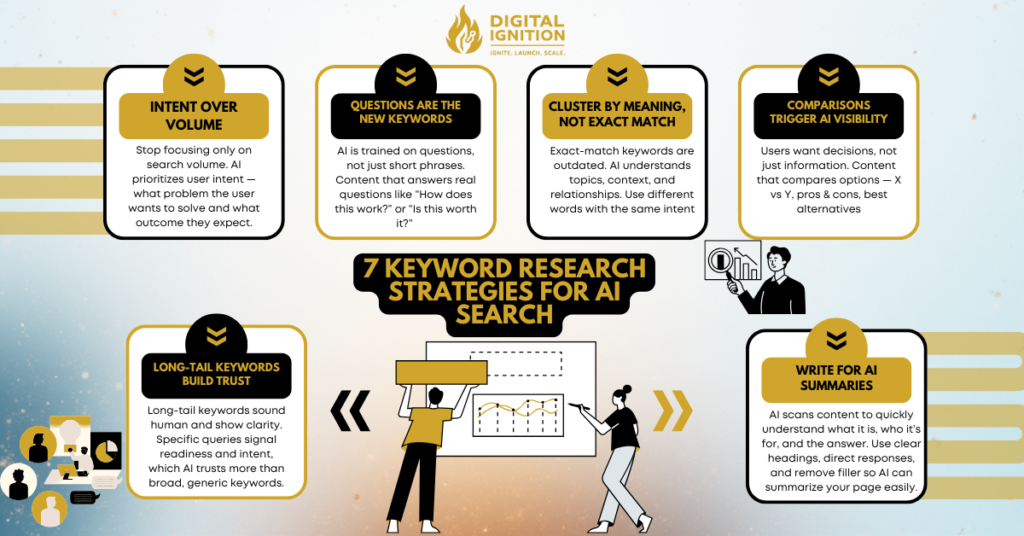
Strategy 1: Intent-First Keyword Research for AI SEO
Intent-first keyword research is the foundation of AI search SEO. Instead of asking, “How many people search this?” you ask, “What problem is the user trying to solve?”
Identifying User Problems, Not Just Phrases
AI search SEO specialists focus on:
- Informational intent (learning)
- Navigational intent (finding)
- Transactional intent (buying)
Each page should target one intent, one outcome, and one primary keyword.
Mapping Intent to Pages
Every keyword should map to a single page purpose. This improves clarity for both users and AI models, increasing your chances of being cited.
Strategy 2: Questions Are the New Keywords
AI is trained on questions, not just keywords. Pages that answer real questions are more likely to be surfaced.
Using Question-Based Queries to Gain AI Visibility
High-performing patterns include:
- How does X work?
- Is X worth it?
- What happens if I do X?
- Best way to do X
Examples of High-Trust Question Keywords
Instead of:
- “SEO tools”
Use:
- “What SEO tools do AI search engines trust most?”
This approach builds relevance and authority.
Strategy 3: Semantic Keyword Clustering by Meaning
Exact-match keywords are outdated. AI groups content by topic, context, and relationship.
Context Over Exact Match Keywords
Different phrases can share the same intent. AI understands this connection and rewards well-structured content clusters.
Building Topic Authority with Clusters
One strong cluster includes:
- Pillar content
- Supporting subtopics
- Internal linking
This signals topical authority to AI systems.
Strategy 4: Comparison Keywords That Trigger AI Summaries
People want decisions, not information. AI loves comparison-based content.
Decision-Based Search Queries
Examples include:
- X vs Y
- Best X for beginners
- X alternatives
- X pros and cons
Examples of AI-Friendly Comparison Content
Comparison content often appears in AI-generated summaries because it helps users decide quickly.
Strategy 5: Long-Tail Keywords Build Trust and Conversions
Long-tail keywords sound human and show intent clarity.
Why AI Prefers Long-Tail Queries
Long-tail keywords:
- Reduce ambiguity
- Show readiness
- Increase trust
Human-Sounding Keywords That Convert
❌ “SEO keywords”
✅ “How to choose AI-friendly SEO keywords for service pages”
AI trusts specificity—and so do users.
Strategy 6: Writing for AI Summaries and Featured Answers
AI scans content rapidly to extract answers.
How AI Scans and Summarizes Content
AI looks for:
- Clear topic definition
- Who it’s for
- Direct answers
Formatting Content for AI Extraction
Use:
- Short paragraphs
- Bullet points
- Clear headings
- Direct responses
This increases AI visibility and readability.
Strategy 7: Kill the Follow-Up Question
The best AI search SEO content ends the search journey.
Creating End-to-End Search Satisfaction
Answer:
- What it is
- Why it matters
- What to do next
When users don’t need another search, AI rewards the content.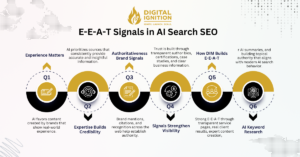
E-E-A-T Signals in AI Search SEO
Experience, Expertise, Authoritativeness, and Trustworthiness are critical.
Brand Authority, Experience, and Trust Signals
Strong E-E-A-T includes:
- Brand mentions
- Real-world experience
- Clear author bios
- Certifications
- Case studies
Agencies like Digital Ignition Media demonstrate these signals through transparent service pages and expert-driven content Digital Ignition Media SEO Services.
How Digital Ignition Media Applies AI Keyword Research
Digital Ignition Media applies AI search SEO by:
- Using intent-driven keyword research
- Creating deep, human-first content
- Structuring pages for AI summaries
- Building topical authority
This approach aligns perfectly with modern AI search behavior.
Frequently Asked Questions (FAQs)
What is AI search SEO?
AI search SEO optimizes content for AI-driven search engines that focus on intent, context, and meaning rather than keywords alone.
Why is keyword intent more important than search volume?
Intent shows what the user actually wants, which AI prioritizes when selecting content.
How many keywords should one page target?
One primary keyword with closely related semantic variations is ideal.
Do long-tail keywords still work for SEO?
Yes, long-tail keywords perform better in AI search due to clarity and specificity.
How does E-E-A-T affect AI SEO?
AI models favor content from trusted, experienced, and authoritative sources.
Can service pages rank in AI search results?
Yes, if they answer real questions clearly and demonstrate expertise.
Conclusion: The Future of Keyword Research in AI Search
AI search didn’t kill SEO—it exposed weak keyword research. AI search SEO specialists who adapt to intent, clarity, and trust will dominate visibility. Those who chase volume alone will keep falling behind.
The future belongs to those who understand meaning, not just metrics.