What is Off-Page SEO?
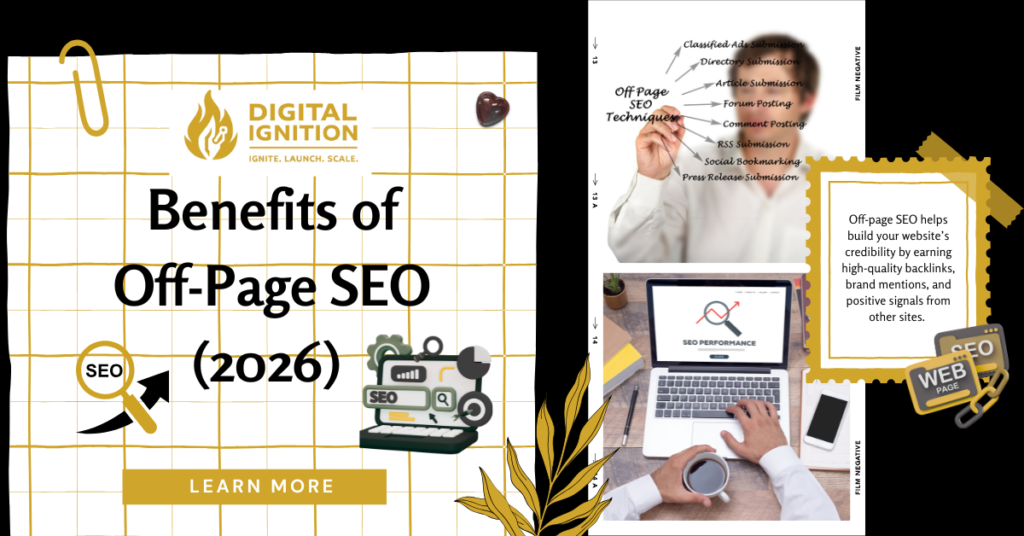
Off-page SEO plays a crucial role in determining how search engines and users perceive your website from the outside. You can think of your website as a store: on-page SEO is what happens inside the store (decor, quality, service), while off-page SEO is the reputation people talk about outside — reviews, recommendations, popularity, and word-of-mouth.
Google relies heavily on these external signals because they help algorithms identify trustworthy brands. Even if your website is perfectly optimized on-page, without off-page signals, it may struggle to rank in competitive niches.
Why Off-Page SEO Matters
Search engines like Google don’t just evaluate your website’s content; they also measure how trustworthy and authoritative you are. Off-page SEO helps search engines understand whether users value your content enough to recommend and share it.
Search engines like Google don’t rely solely on the content published on your website. They also evaluate:
- Who is talking about your brand
- Where your site is referenced
- How frequently your brand is mentioned
- The authority of websites linking to you
- How users engage with and share your content
Off-page SEO helps search engines determine:
✔ Trustworthiness
Are reputable websites referencing or endorsing your content?
✔ Authority
Do high-authority domains consider your brand a credible resource?
✔ Popularity
Is your content being shared, discussed, or cited across the web?
✔ Relevance
Are your backlinks and mentions coming from relevant industries and topics?
When these signals align, Google considers your website a strong candidate for top search rankings, leading to more organic visibility, traffic, and conversions.
Boosting Website Authority
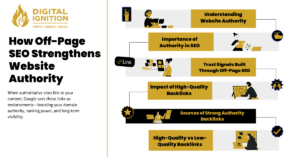
Website authority is essentially your site’s “reputation score.” Off-page SEO boosts this score by helping Google understand how influential your site is. For example, if a respected industry blog links to your content, Google interprets it as a vote of confidence. The more of these votes you accumulate, the more trustworthy your website becomes.
A strong authority profile also means you can rank for competitive keywords faster than low-authority sites. This is why companies invest thousands in quality outreach, digital PR, and authority-building campaigns.
How Backlinks Increase Authority
Backlinks act like digital endorsements. When authoritative websites link to yours, Google interprets it as a sign of trust. This boosts your domain authority and improves your overall online reputation.
Good backlink sources include:
- Educational websites
- Government websites
- Trusted news platforms
- Niche industry blogs
These links carry far more weight than random links from unrelated or spammy sites.
High-Quality vs Low-Quality Backlinks
Not all backlinks are equal:
| Factor | High-Quality Backlinks | Low-Quality Backlinks |
| Impact on SEO | Boost rankings, increase authority, strengthen trust signals | Harm rankings, dilute authority, may trigger Google penalties |
| Domain Source | Reputable, niche-relevant, authoritative websites | Irrelevant, spammy, low-authority, or artificially created sites |
| Relevance | Contextual and related to your industry/topic | No industry relevance or random foreign-language sites |
| Examples of Sources | Editorial mentions, authoritative guest posts, resource pages, PR/news coverage, expert collaborations, influencer references | Link farms, spam directories, comment spam, PBNs, paid/rented footer or sidebar links |
| Google’s View | Considered natural, trustworthy, and valuable | Considered manipulative, toxic, and unnatural |
| Level of SEO Value | Very high — one good backlink can outweigh hundreds of weak links | Very low — often harmful instead of helpful |
| Risk Level | No risk when acquired ethically | High risk of algorithmic penalties or manual actions |
| Long-Term Benefit | Improves long-term domain authority & keyword performance | Damages long-term SEO health and may require disavowal |
Improving Search Engine Rankings
Off-page SEO directly influences how Google perceives the popularity and authority of your website. When your backlinks, brand mentions, and social presence grow, Google begins ranking your pages higher — even if your competitors have similar on-page optimization.
The beauty of off-page SEO is that its effects apply across your entire website, not just one page. This means ranking improvements often occur sitewide.
Role of Google’s Algorithm
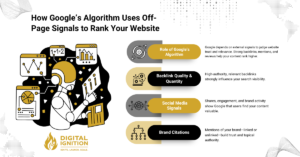
Google relies heavily on external ranking signals. Backlinks, brand mentions, and reviews all tell Google that your content is reliable and deserves a higher place in search results.
Off-Page Signals That Affect Ranking
- Backlink quality and quantity
- Social media signals
- Brand citations
- Online authority
- User engagement
- Content co-citations (your brand mentioned without a link)
- Brand SERP improvements
- User-generated content referencing your brand
- Press releases and media coverage
These signals help Google understand that people are talking about and trusting your brand online.
Increasing Organic Traffic
Organic traffic is the lifeblood of any website because it brings consistent, free, high-intent visitors. Off-page SEO helps increase organic traffic by boosting visibility and ranking positions. The more authoritative your website becomes, the more keywords you start ranking for automatically.
Additionally, backlinks from popular websites send referral traffic, exposing your content to new audiences.
Referral Traffic Explained
Referral traffic comes from other sites linking to yours. The more high-authority websites you’re mentioned on, the more targeted visitors you’ll receive.
Referral traffic tends to convert better than regular traffic because it comes from relevant sources.
For example: If a fitness blogger links to a workout equipment store, the traffic from that blog is highly targeted and more likely to buy.
Social Traffic and Brand Exposure
Active social media sharing increases visibility. When your content is shared, liked, or discussed, it expands reach and naturally brings more visitors to your site.
Social platforms act like megaphones for your brand. The more times your content is shared, the larger your audience becomes. And even though social signals are not direct ranking factors, they indirectly boost SEO by increasing:
- Content exposure
- Brand visibility
- User engagement
- Backlink opportunities
Many viral posts have resulted in natural backlinks from journalists, bloggers, and influencers.
Strengthening Brand Reputation
Users trust brands that appear consistently across multiple platforms. Off-page SEO builds this trust through reputation signals. A brand with positive reviews, strong social presence, and mentions across the web is naturally seen as more credible.
Reputation is becoming even more important as Google moves toward E-E-A-T (Experience, Expertise, Authority, Trust).
Social Proof and Trust Signals
Off-page SEO builds credibility. A brand with strong external signals appears trustworthy to users. Social media engagement, influencer mentions, and positive reviews all contribute to a strong online reputation.
Examples of trust signals include:
- Verified social media profiles
- High review scores
- Influencer endorsements
- Positive industry mentions
- Awards or recognitions
These not only help with conversions but also strengthen SEO performance.
Online Reviews and Their Impact
People trust online reviews just as much as personal recommendations. Good reviews boost brand image, while negative ones can harm your reputation. Managing reviews is a crucial part of off-page SEO.
Enhancing Online Visibility
Online visibility determines how easily people can find your website. Off-page SEO increases visibility by placing your brand on different platforms such as:
- Guest blogs
- Podcasts
- YouTube channels
- Social media networks
- Business directories
The more places your brand appears, the more awareness you build — which eventually translates into higher search demand.
Guest Posting and Brand Mentions
Publishing articles on other websites exposes your brand to new audiences. Guest posting not only builds authority but also helps generate valuable backlinks.
Social Media Engagement
Active participation on social platforms helps your brand stay relevant. Shares, comments, and likes are strong indicators of engagement and visibility.
Boosting Domain Authority (DA) & Page Authority (PA)
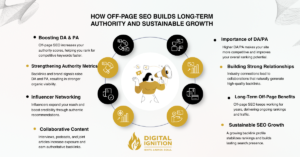
Off-page SEO is the only way to increase DA and PA. These metrics are widely used to estimate ranking potential. When your domain authority grows, Google begins trusting your website more — allowing you to rank for competitive and high-volume keywords faster.
A higher DA also means new pages can rank more quickly, reducing the need for long-term content promotion.
Why DA/PA Matter for SEO
Domain Authority (DA) and Page Authority (PA) measure how well your website is likely to perform in search engines. The higher these scores, the more competitive your site becomes.
How Off-Page SEO Strengthens These Metrics
Backlinks, social signals, and brand mentions directly contribute to increasing both DA and PA. Over time, these improvements translate into higher rankings and more organic traffic.
Building Strong Relationships
Relationship-building is an underrated but powerful aspect of off-page SEO. By connecting with industry leaders, bloggers, influencers, and journalists, you can unlock opportunities such as:
- Joint webinars
- Expert roundups
- Collaborative blog posts
- Social shoutouts
- Podcast guesting
These collaborations help build brand exposure while also generating natural, high-authority backlinks.
Networking with Influencers
Off-page SEO encourages relationship-building with industry leaders. Influencers can amplify your reach and recommend your content to a much wider audience.
Collaborative Content Opportunities
Partnerships—like interviews, podcasts, and joint articles—boost exposure and create high-value backlinks naturally.
Long-Term SEO Benefits
Off-page SEO is not a one-time activity — it’s a long-term asset. Backlinks, brand mentions, exposure, and authority continue benefiting your website for years. Unlike paid ads, which stop working the moment you stop paying, off-page SEO keeps driving traffic and rankings long-term.
Furthermore, once you build domain authority, competitors have a much harder time overtaking your rankings.
Sustainable Growth Over Time
Unlike paid ads, off-page SEO delivers long-lasting results. As your backlink profile grows and your reputation strengthens, your rankings become more stable.
Compounding Benefits of Off-Page Efforts
Each successful off-page strategy builds on the previous one. More backlinks lead to better rankings, which attract more visitors, resulting in even more backlinks.
It’s a powerful cycle.
FAQs
1. Is off-page SEO more important than on-page SEO?
Both are essential, but off-page SEO determines how the world perceives your website, making it equally—if not more—important.
2. How long does it take for off-page SEO to work?
Typically 2–4 months, depending on niche competitiveness and backlink quality.
3. What are the most effective off-page SEO techniques?
High-quality backlinks, social media engagement, guest posting, and brand mentions.
4. Can off-page SEO improve my website’s trustworthiness?
Yes, positive reviews, strong backlinks, and social proof all boost credibility.
5. Do social media signals affect SEO?
Yes, social engagement increases visibility and indirectly helps rankings.